Housewives in Jatitengah Village Empowered Through Waste Bank Training Program
Published on September 15, 2025
Housewives in Jatitengah Village Empowered Through Waste Bank Training Program
Bojonegoro – A community service initiative in Jatitengah Village, Sugihwaras District, Bojonegoro Regency, has successfully empowered local housewives by establishing a waste bank as a means of tackling environmental issues and creating new sources of income. Conducted in July 2019, the program was organized by lecturers from the Faculty of Economics and Business, Universitas Airlangga in collaboration with Yayasan Mandiri Ukhuwah Persada, with active support from the village government and women’s groups (PKK).
Jatitengah Village, home to around 3,000 residents, is largely dependent on agriculture, with most men and women working as farmers or farm laborers. While families with larger plots of land enjoy stable harvests, many others, especially farm laborers, struggle with limited income and periods of unemployment outside of planting and harvest seasons. At the same time, household waste management remained a persistent problem. Waste was often burned or dumped carelessly in fields, causing environmental degradation, unpleasant odors, and health risks.
To address these twin issues of economic vulnerability and poor waste management, the program introduced the concept of a waste bank, where waste can be collected, sorted, and given financial value. The training targeted housewives, who play a key role in managing household waste but had little prior knowledge about waste recycling and its economic potential.
The first stage of the program focused on socialization. Participants were introduced to the principles of waste banks, including how waste is categorized, its market value, and how it can be managed collectively to benefit the community. The facilitators also emphasized the health and environmental benefits of proper waste management, encouraging participants to view waste not as a burden, but as a resource.
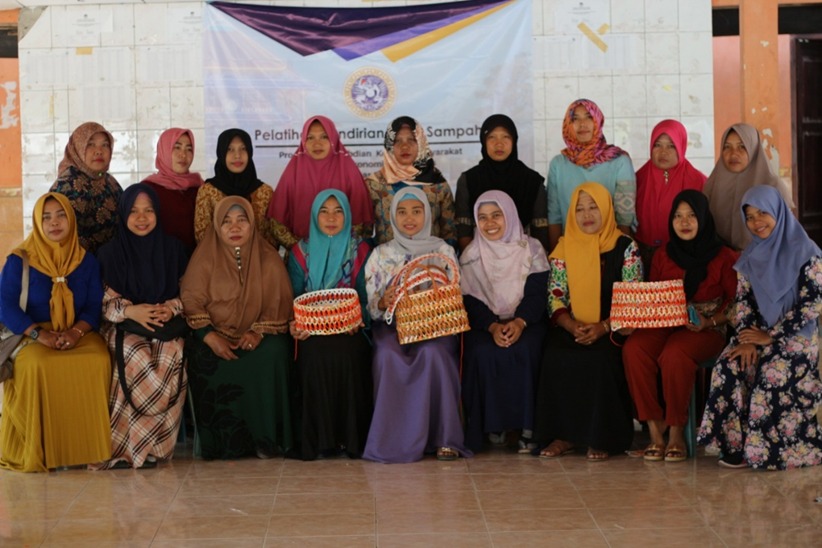
Following this, practical training was held at the Jatitengah Village Hall, attended by 20 women aged 30 and above. Under the guidance of trainer Sri Utami, the participants learned how to recycle used plastic cups into attractive woven handbags. The training included step-by-step instructions on preparing materials, weaving techniques, and finishing touches to enhance product value. The activity was met with enthusiasm, as participants not only gained hands-on skills but also realized the potential of turning household waste into creative, sellable products.
The program’s outcomes went beyond skills training. It aimed to instill a long-term mindset of environmental responsibility and self-reliance among the women. Plans were made to formally establish the waste bank with an organizational structure, including divisions for administration, finance, customer service, innovation, and security. The system will ensure proper waste sorting at the household level, standardized collection schedules, and accurate bookkeeping.
To further strengthen the program, future stages include comparative studies to successful waste banks in Malang, which are known for their advanced management systems and innovative recycling practices. By learning from these models, Jatitengah’s waste bank is expected to grow more sustainable and impactful, offering both environmental and economic benefits.
Participants expressed their appreciation for the program, noting that it opened their eyes to new opportunities. “We never thought waste could be transformed into something beautiful and valuable. Now we can contribute not only to a cleaner environment but also to our family income,” one housewife said.
The program produced several outputs, including journal and media publications, video documentation, and most importantly, a motivated group of housewives ready to operate the waste bank. With continuous support from the village government and community leaders, the initiative is set to become a model for rural waste management and women’s empowerment in Bojonegoro.
By combining environmental awareness with practical economic solutions, the Jatitengah waste bank initiative demonstrates how community service can transform everyday challenges into sustainable opportunities for growth and empowerment.